Skip to content

CPaaS / Your calling setup

AI voice agents
for Telnyx.

AI voice agents layered on Telnyx, or replacing the AI leg entirely.
CPaaSNo import needed to start
PyAI / WorkspaceActual product
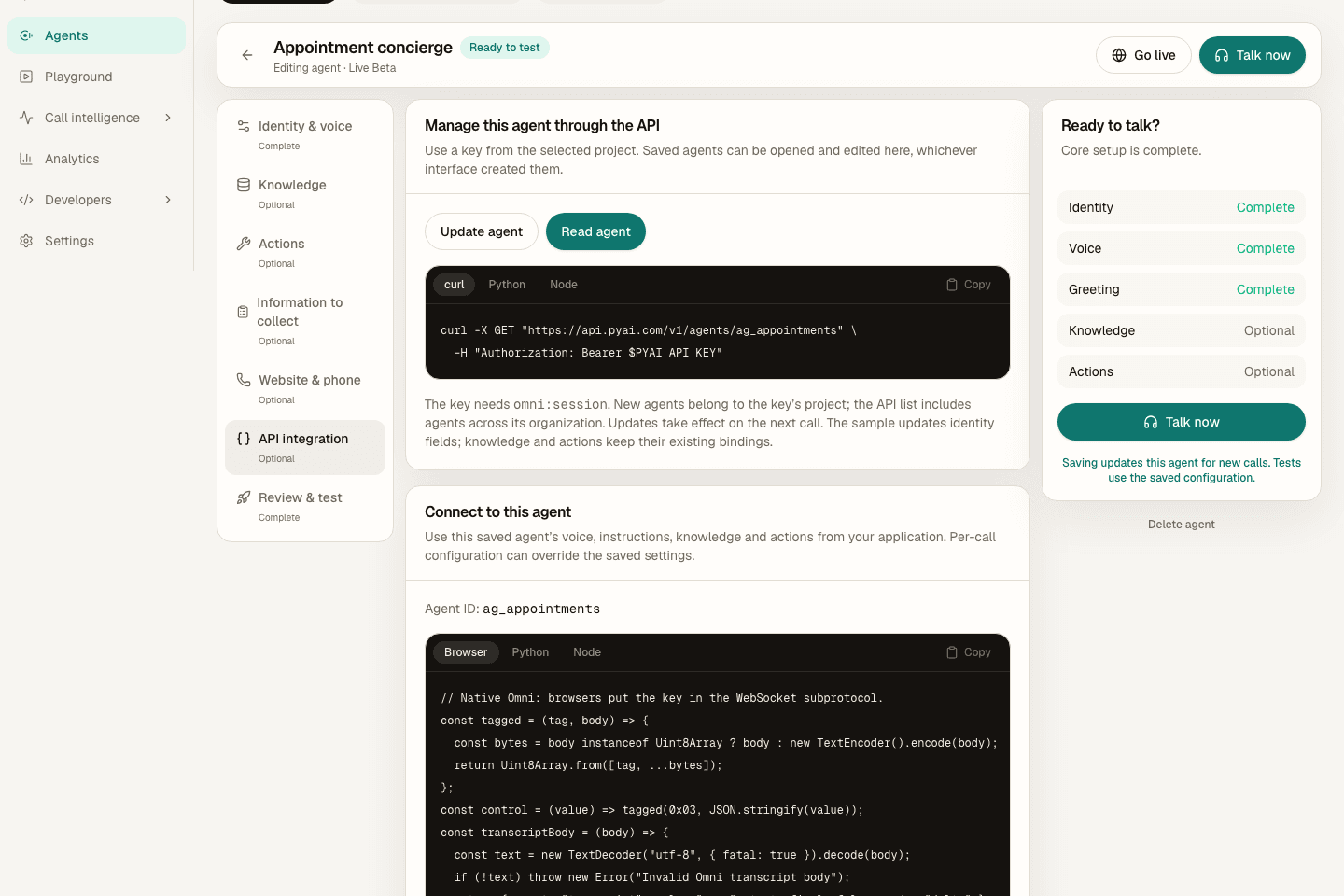
Actual PyAI Console showing the Agents API integration panel with sample workspace data
The actual PyAI Console API panel, shown with sample data. Connect it to your own calling workflow.Explore Omni

Keep the parts that already work

Two ways in.
Choose by call type.

Telnyx teams usually keep Telnyx for transport and add intelligence elsewhere. Point chosen numbers at a PyAI number for AI-answered calls, or build the intelligence leg on PyAI's APIs directly and let Telnyx do what it does best.

Path 1: Forward calls to PyAI

Keep everything exactly where it is. PyAI provisions a number (or takes your SIP trunk), you point your calls at it, and a PyAI agent answers with your greeting, your knowledge, and your tools. Your platform keeps billing you for lines; the AI layer lives at PyAI.

  1. 01In the PyAI console, provision a number (Phone) or bring your own SIP trunk.
  2. 02Build the agent: pick a voice, write the greeting, connect your knowledge and tools, then call it yourself to test.
  3. 03Set the forward on your side using the hint below, aimed at the PyAI number.
  4. 04Place one real call. The agent answers; the recap and QA land in PyAI and any tools you connected.

On Telnyx: Telnyx Mission Control: set the number's call handling to forward, or divert on your SIP trunk to PyAI.

Path 2: Integrate via API

Add the AI layer where it belongs: one OpenAI-compatible key for hearing, speaking, and full voice agents.

  • Omni voice agents with managed telephony: one model handles hearing, reasoning, and speech on the call.
  • Streaming speech-to-text for your own pipeline, plus Omni's documented native realtime protocol for agents.
  • AMD for outbound dialing efficiency, delivered over a Twilio Media Streams-compatible socket many CPaaS bridges already speak.
Explore the Omni SDK path

See the workspace behind it

Make the setup
your own.

Write the instructions, choose a voice and connect the knowledge and tools for the job. Then test the conversation before connecting it to your callers.

Explore Agents

Follow the real Console with a sample workspace, narrated by Aria, our Natural English voice.

Product tour
Actual Console UI · sample workspaceAria Natural · PyAI Speak

Start at the right depth

A useful first call.
Room to build from there.

Call forwarding, API integration and completed-call import are separate paths. Choose the one that fits the workflow you want to run first.

Start with forwarding

Send a selected call type to PyAI and keep your Telnyx setup for the rest. Configure the agent, set the transfer path and test a real call before widening the route.

Add the API when it fits

Own more of the call flow or connect speech to your application. Hear and Speak support OpenAI-compatible shapes; Omni uses its native realtime protocol through the official SDK.

Keep import status clear

A native Telnyx importer is not available. Start with forwarding or a direct API workflow, and keep the rest of your calling setup in place.

Before you connect the first call

Your platform.
A clearer way in.

Choose the calling path first, then check the current product and import requirements for your setup.

Do I have to leave Telnyx to use PyAI?

No. Most teams start with call forwarding: Telnyx keeps the lines and the bill, and PyAI answers the calls you point at it. If and when it makes sense, you can also build directly on PyAI's APIs or import completed calls.

What does the AI voice agent actually do on a call?

It answers in your voice and greeting, holds a real conversation at human pace, uses your knowledge base and tools, and can transfer to a human, collect details, or end the call politely. Afterward you get the recap and, with Trace, a compliance scorecard.

Is call import from Telnyx available?

There is no native Telnyx importer today, and you do not need one to start: forwarding sends the calls you want AI-answered to PyAI. Importer candidates are prioritized by customer demand, so ask.

What does this cost?

You pay PyAI for the calling and call intelligence you run (per-minute calling, Recap or AMD usage); integrations carry no extra fee. Your existing platform bills you as usual for the lines you keep.

Put a voice agent on your Telnyx calls.

Sandbox keys never bill. Test the workflow, then fund a live key when you are ready for production traffic.