Skip to content
Brand & press

Press kit.

Copyable descriptions, the numbers that matter, popular use cases, screenshots, and logos. Built so press and partners can write about PyAI accurately in a few clicks.

Every block below has a Copy button. The kit includes all logos as SVG plus PNGs from 16px to 1024px.

What is PyAI?

Two versions of the company description. Click Copy and paste the one that fits.

One paragraph

PyAI is an OpenAI-compatible voice AI platform built for the phone. It covers the full call path behind one API key: Hear for speech-to-text, Speak for text-to-speech and voice cloning, Omni for realtime voice agents, plus Trace for compliance and Cast for long-form audio. Teams point an existing OpenAI SDK at api.pyai.com, change two lines, and pay per minute with no seats, no platform fee, and no token math.

Full boilerplate

PyAI is a telephony-native voice AI platform. Instead of stitching together a separate speech-to-text vendor, language model, text-to-speech engine, and compliance tool, PyAI delivers the whole call path behind a single API key and one per-minute rate.

The platform spans five products. Hear is speech-to-text tuned for 8 kHz call audio, with streaming partials and a half-price async batch tier. Speak is low-latency text-to-speech with 36 stock voices and free voice cloning and design. Omni is an end-to-end realtime voice agent over a single WebSocket that listens, reasons, retrieves from your knowledge bases, and speaks, at $0.05 per minute all-in. Trace scores every call against compliance rule packs such as TCPA, HIPAA, and PII. Cast produces long-form emotional audio for podcasts, narration, and audiobooks at $1.20 per finished hour.

PyAI is OpenAI-compatible, so developers keep their existing SDK and error handling and only change the base URL and key. Billing is per second for AI products, with no seats, no monthly minimum, and a sandbox key that works instantly and never bills.

Products & the numbers

Each product with a one-line description, a copyable paragraph, and the published stats. No accuracy claims here; independent benchmarks are linked from the product pages.

Hear

Speech-to-text tuned for the phone.
Hear description

Hear is PyAI's speech-to-text product, tuned for 8 kHz telephony audio rather than studio recordings. It is Whisper-compatible, streams partial results as words are spoken, and offers an async batch tier at half the streaming price. Hear starts at $0.003 per minute, with 10,000 free transcription minutes every month, and independent accuracy benchmarks are published by Artificial Analysis.

Speak

Text-to-speech that starts in milliseconds.
Speak description

Speak is PyAI's text-to-speech product. Audio streams from the first byte, with time-to-first-byte in the tens of milliseconds, so playback begins almost immediately. It ships with 36 stock voices, and both voice cloning enrollment and prompt-to-voice design are free. Speak is $0.06 per minute and uses the same OpenAI audio API shape.

Omni

Realtime voice agents over one WebSocket.
Omni description

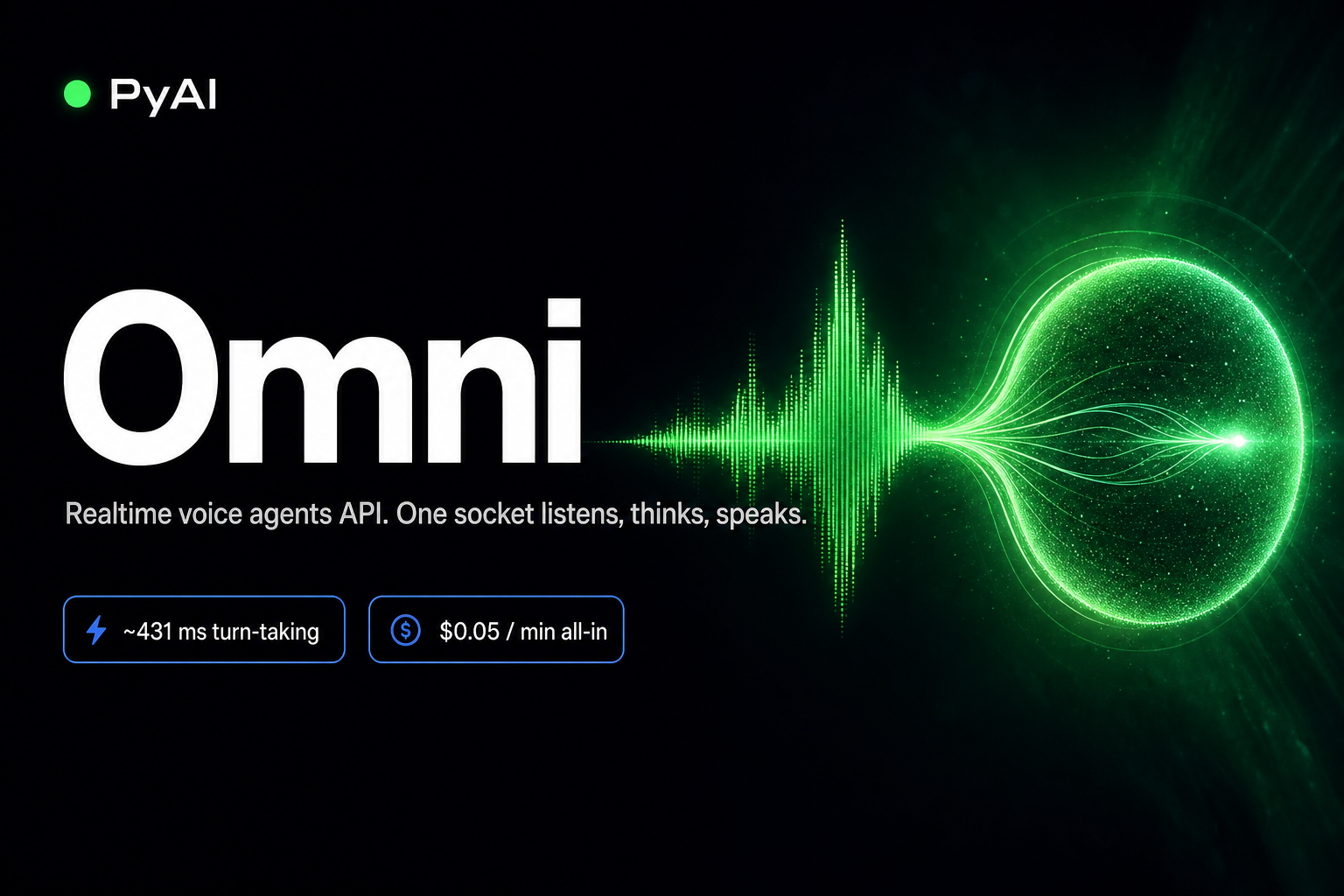
Omni is PyAI's realtime voice agent. A single WebSocket listens, reasons, retrieves context from your knowledge bases and tools, and speaks back, with natural turn-taking and barge-in. Median turn-taking is around 431 milliseconds. Omni is $0.05 per minute all-in, with transcription, reasoning, retrieval, and synthesis included in one flat rate, and an OpenAI realtime-compatible URL is available.

Trace

Compliance and QA on every call.
Trace description

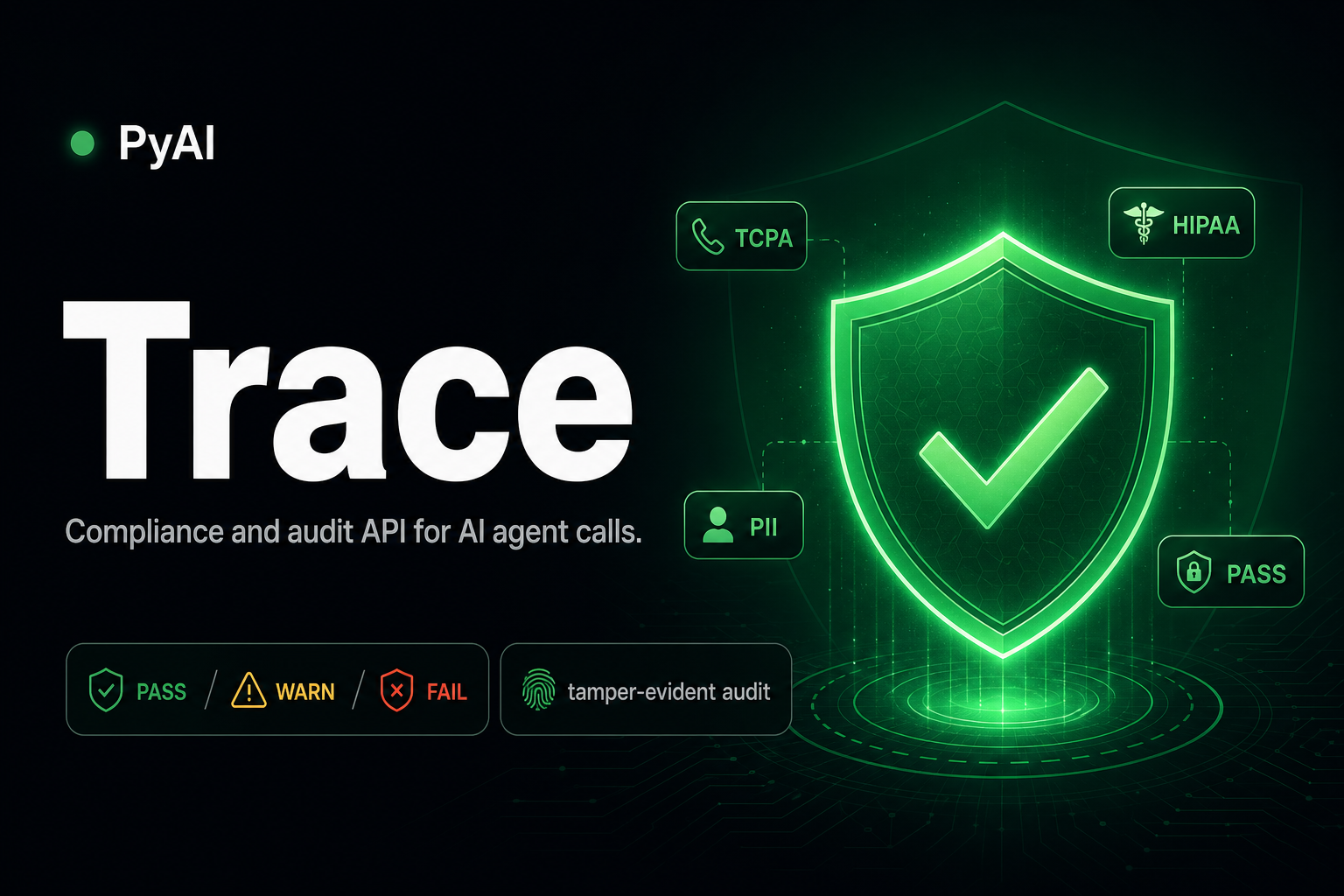
Trace scores every call against rule packs such as TCPA, HIPAA, PII, and brand-voice, and returns a per-call scorecard with a PASS, WARN, or FAIL verdict, findings that cite the exact regulation, automatic redaction of sensitive data, and a tamper-evident audit hash. It runs on Omni calls or on your own stack, at $0.05 per minute scanned, so teams can monitor 100% of calls instead of sampling.

Cast

Emotional long-form audio for production.
Cast description

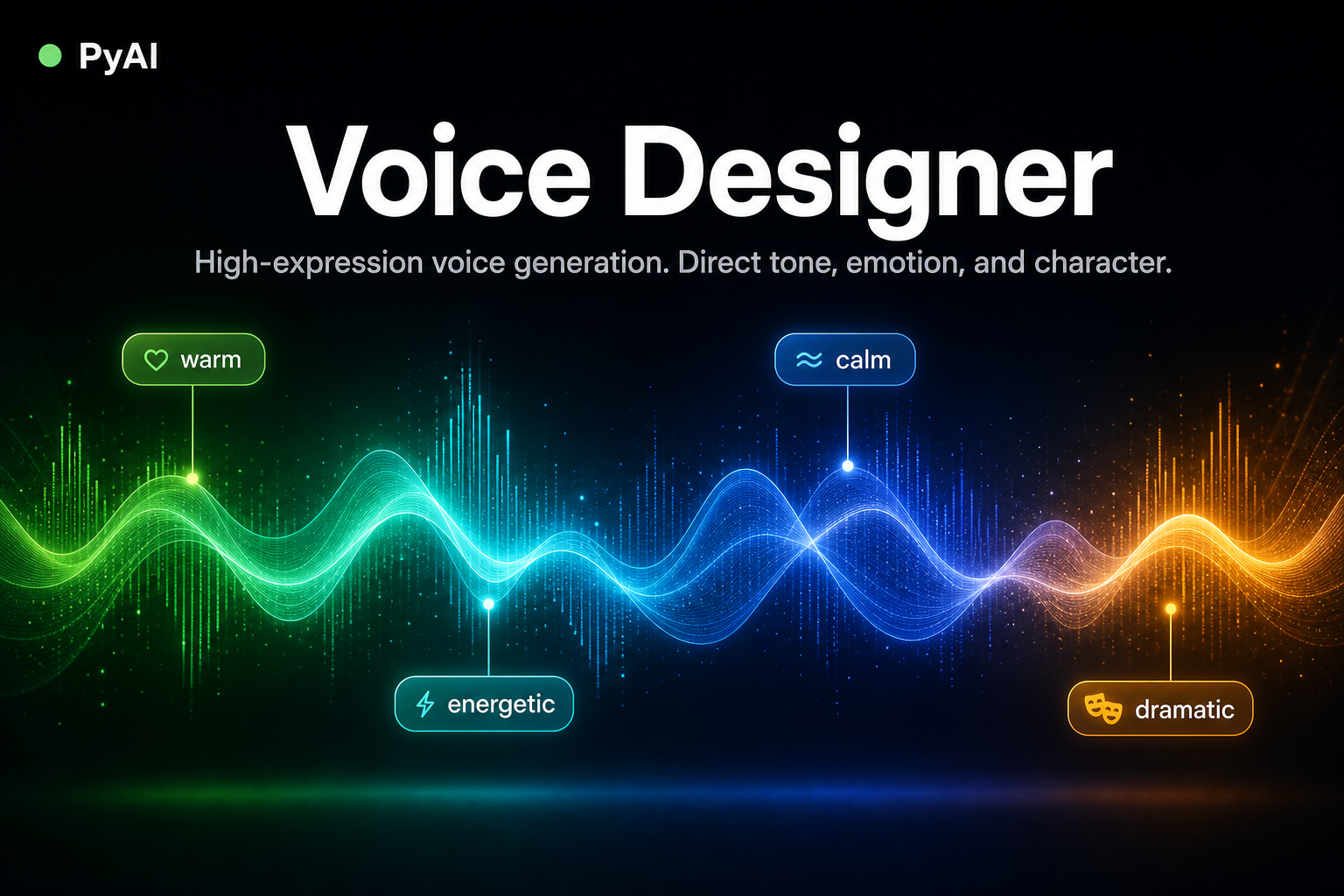
Cast is PyAI's long-form text-to-speech product for podcasts, narration, audiobooks, education, and brand audio. It pairs expressive, directable voices with included commercial rights and a free Voice Designer. Cast is $0.02 per minute, or $1.20 per finished hour, so a 10-hour audiobook costs about $12 with no character counting.

Where PyAI is used

The patterns we see most across direct customers and integration partners.

Direct customers

AI receptionists and front desks

Inbound answering, routing, and FAQ handling for clinics, salons, and local services, grounded in the business's own knowledge base.

Appointment booking and reminders

Agents that schedule, confirm, and reschedule over the phone, then write back to the calendar or CRM through webhook tools.

Outbound qualification and follow-up

Lead qualification, renewals, and reactivation calls priced per minute, so teams can scale volume without scaling headcount.

Compliance-heavy call centers

TCPA, HIPAA, and PII monitoring on every call with Trace, replacing 2% manual QA sampling with 100% automated scoring.

Integration partners

Platforms embedding voice

Vertical SaaS and CRM products that add voice agents to their own app using the OpenAI-compatible API, keeping their existing stack.

Agencies and builders

Teams shipping voice agents for multiple clients, using managed telephony at $0.01 per minute instead of per-client carrier contracts.

Bring-your-own-stack integrations

Partners who keep their own language model and voice but use Cue for the hard realtime parts: turn detection and grounded knowledge-base context.

Languages & local-language support

PyAI supports multilingual and local-language voice agents by combining the right pieces for each call. Hear transcribes the caller, Cue handles turn detection and grounded context, and the agent answers with the voice of your choice through Speak or a cloned voice. Because PyAI is composable and bring-your-own-stack friendly, teams can mix the transcription, language model, and text-to-speech that best fit a given language or region rather than being locked to one fixed pipeline.

Screenshots

Representative product visuals for articles and decks. Click any image to open it full size, then save.

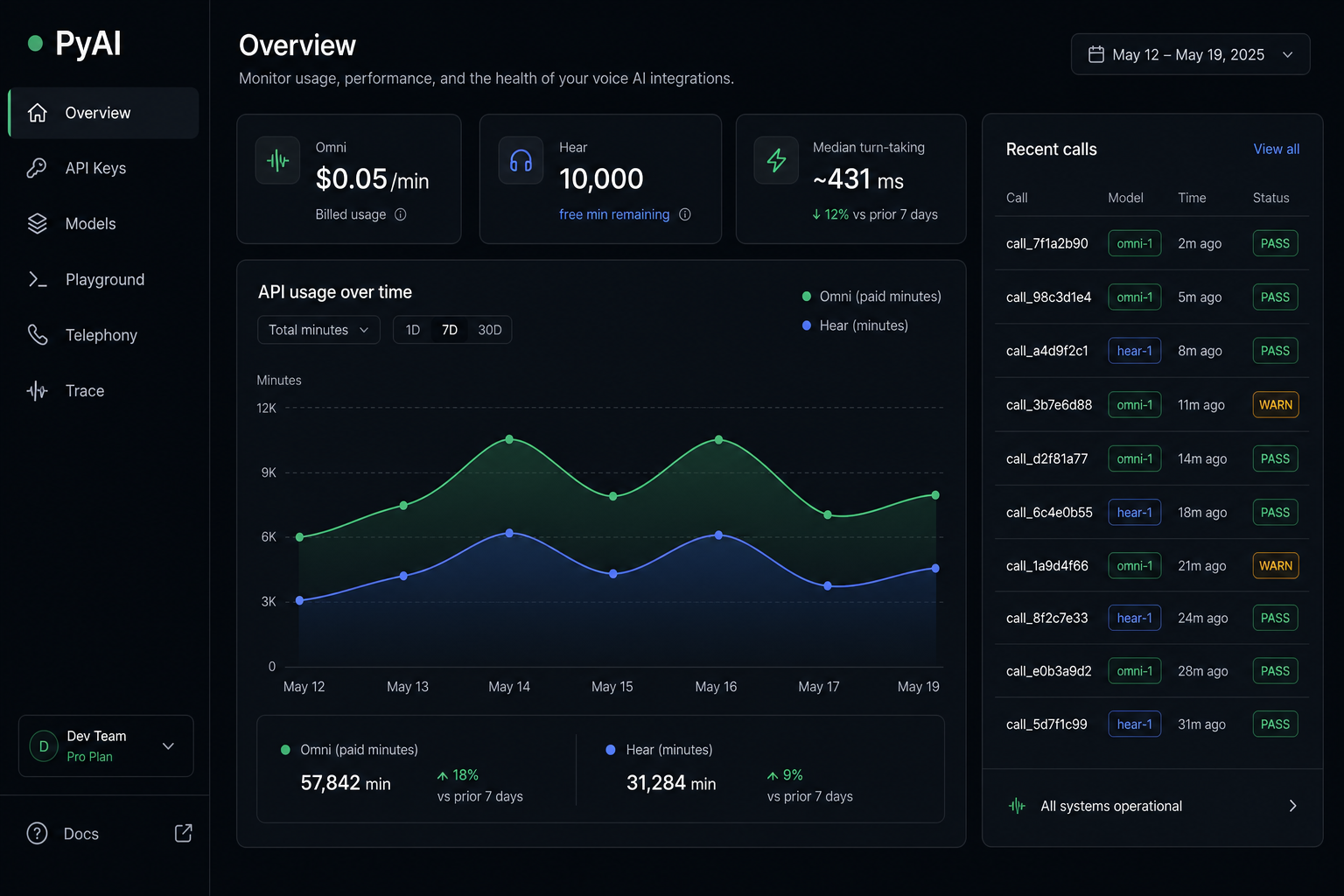
PyAI Console dashboard

Console dashboard

PNG

Usage, spend, and call health across every PyAI product in one view.

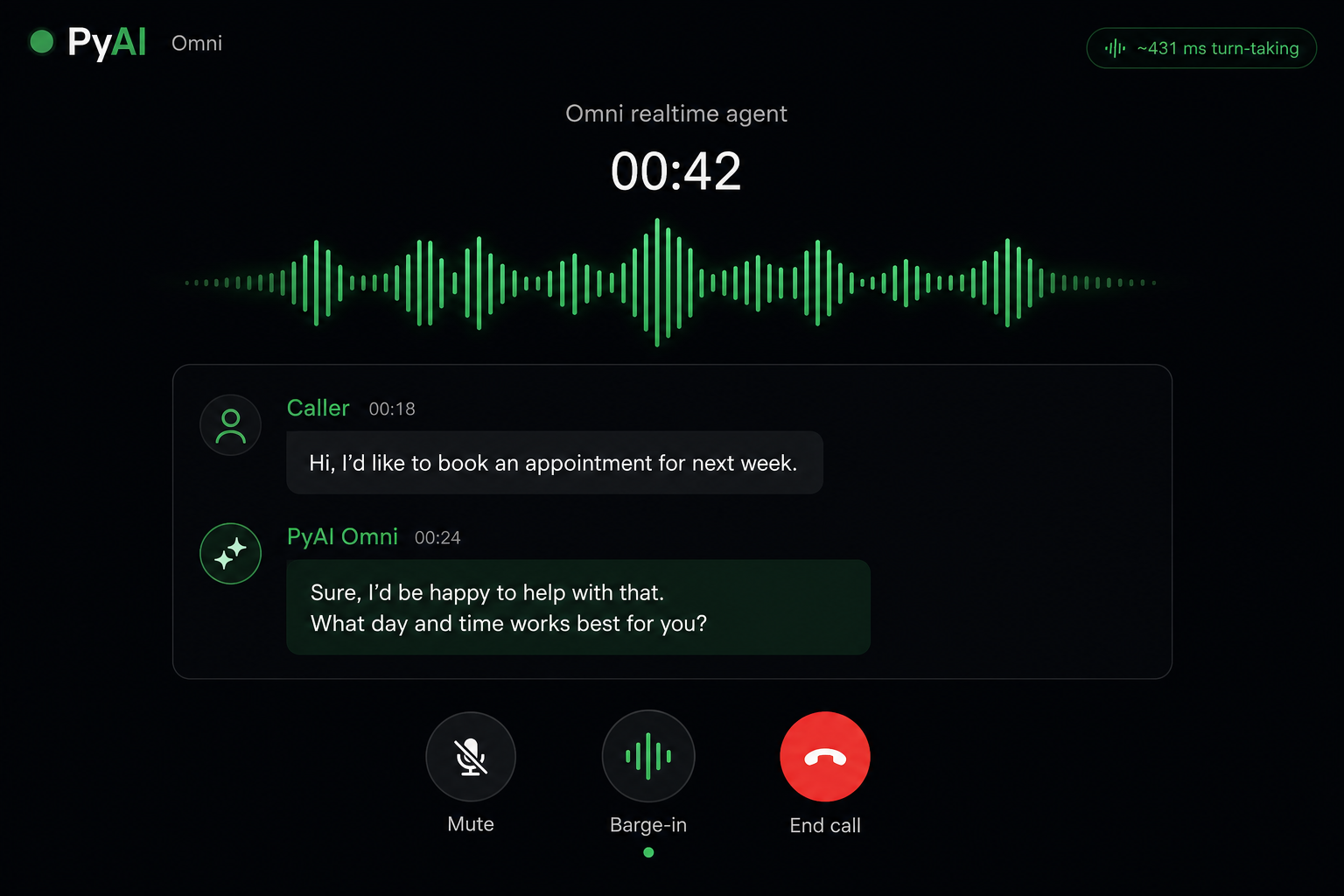
PyAI Omni realtime agent

Omni realtime agent

PNG

An end-to-end voice agent with natural turn-taking and barge-in.

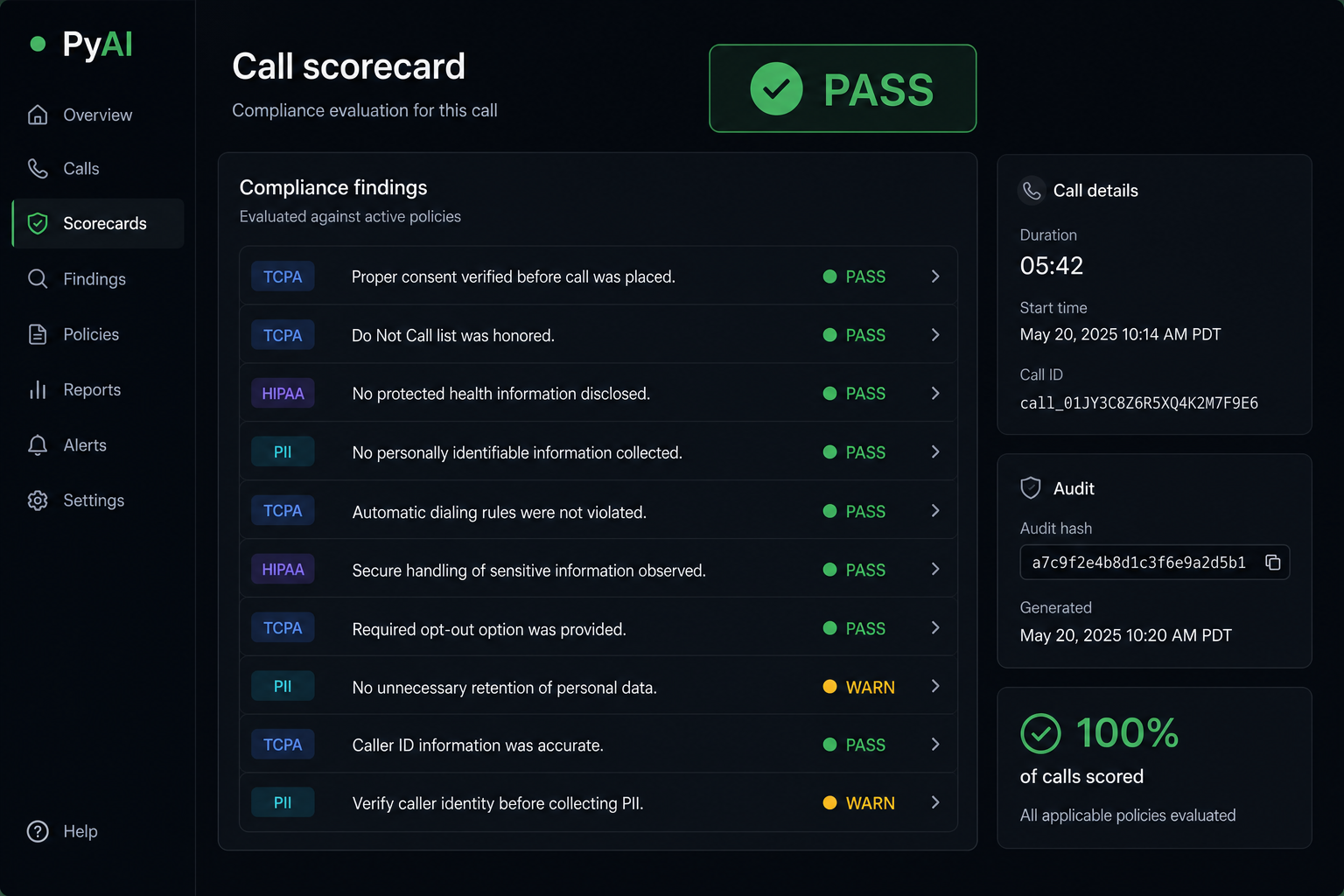
PyAI Trace compliance scorecard

Trace compliance scorecard

PNG

A per-call PASS, WARN, or FAIL verdict with findings and an audit hash.

Logo

The PyAI mark is the status dot: a solid circle inside a soft ring, set in a dark rounded-square chip. Use the SVG wherever you can; PNGs are provided for everything else.

PyAI Mark, green

Mark, green

on dark

Primary app icon and status or operational contexts.

PyAI Mark, blue

Mark, blue

on dark

Alternate accent mark for general brand placements.

PyAI Mark, green

Mark, green

on light

The same mark reads cleanly on light surfaces too.

PyAI Horizontal lockup

Horizontal lockup

on light

Mark plus PyAI wordmark. The header default.

PyAI Horizontal, on dark

Horizontal, on dark

on dark

White wordmark variant for dark backgrounds.

PyAI Stacked lockup

Stacked lockup

on light

Mark above the wordmark, for square and centered spots.

Colors

Click any swatch to copy its hex. Green is the operational color and the primary mark; blue is the alternate accent.
Clear space & minimum size

Keep clear space around the mark equal to the diameter of its dot, and do not render it below 16px. That breathing room is the whole spec.

48px
32px
16px min

Below 16px the ring closes up, so use the bare dot or step back up. Reach for the SVG so edges stay sharp at every scale.

What not to do

One rule, shown four ways: use the supplied files as they are. Do not redraw, recolor, or dress up the mark.

Do not stretch or distort
Do not rotate
Do not recolor the mark
Do not add effects or shadows

Naming & spelling

Company & product
Always PyAI: capital P, capital A, capital I. Not “Pyai”, “PYAI”, or “pyAI”.
Product names
Hear (speech-to-text), Speak (text-to-speech and cloning), Omni (realtime voice agents), Trace, Cast. Capitalize as shown.
One-liner
The best voice AI for telephony.

Writing about PyAI?

Grab the brand kit above, or reach out and we will get you whatever you need: quotes, screenshots, or founder availability.

No credit card - OpenAI-compatible - cancel anytime